



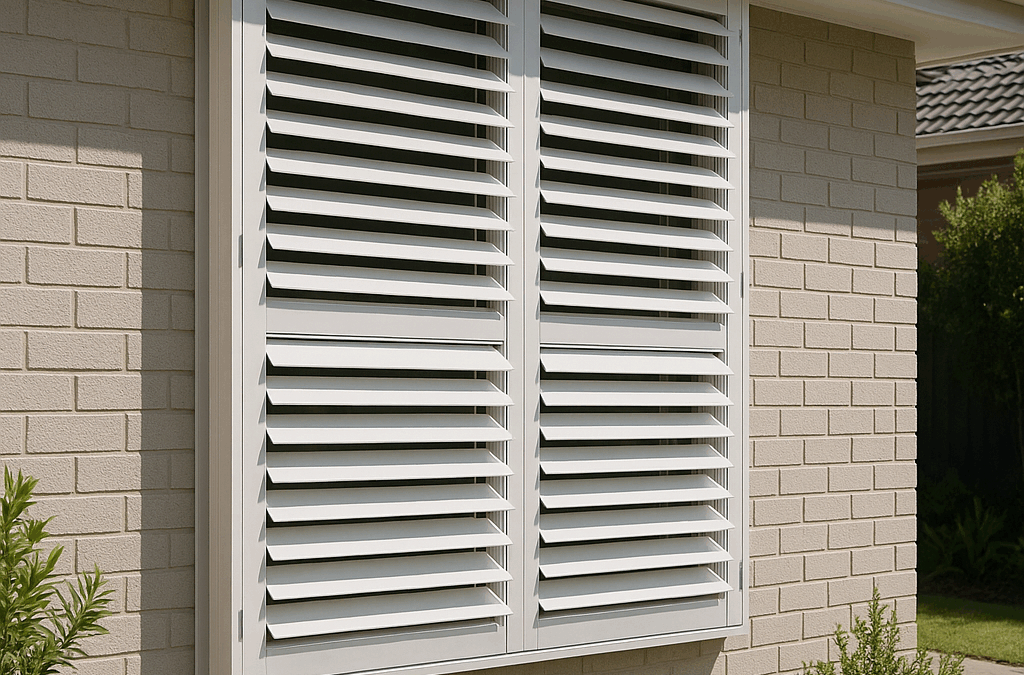
If you have explored outdoor plantation shutters in Melbourne, you already know the core dilemma: do you prioritise privacy, shade, airflow, or all three? The good news is that modern aluminium plantation shutters genuinely deliver on every front. Unlike older timber alternatives, today’s powder-coated aluminium shutters are built specifically for Melbourne’s unpredictable climate. Furthermore, they sit at a price point that competes with premium outdoor blinds over a full product lifespan. Whether you are enclosing a balcony, screening a pool area, or adding architectural character to a heritage streetscape, this guide answers the questions Melbourne homeowners actually ask before they buy.
Throughout this article, we will cover material comparisons, airflow control, weatherproofing, heritage overlay considerations, balcony and pool applications, maintenance realities, cost factors as of mid-2026, and an honest comparison with alternatives like cafe blinds. By the end, you will have the information you need to make a confident, well-informed decision.
What Makes Outdoor Plantation Shutters Different from Indoor Ones?
Most people associate plantation shutters with interior window treatments. However, outdoor variants serve an entirely different structural and functional purpose. Indoor shutters use materials like PVC, basswood, or MDF. Outdoor shutters, by contrast, are almost universally constructed from marine-grade or architectural aluminium.
The distinction matters enormously in Melbourne. Indoor-rated materials deteriorate quickly when exposed to UV radiation, rainfall, and temperature swings. Moreover, outdoor shutters carry specific engineering requirements for wind load resistance. According to the Australian Building Codes Board, building products used in exterior applications must meet relevant performance standards under the National Construction Code. Therefore, never use an indoor-rated shutter in an outdoor position.
Additionally, outdoor versions feature heavier-duty hinge systems, concealed fixings, and louvre blades designed to flex under wind pressure without bending permanently. The result is a product that looks refined while performing like structural cladding.
Interestingly, the adjustable louvre design — which controls light and airflow — is one of the biggest reasons Melbourne homeowners choose shutters over fixed screening. You can angle louvres to admit a breeze while maintaining complete visual privacy from neighbouring properties. That level of precision simply is not achievable with roller blinds or solid panel systems.
Aluminium vs Timber for Outdoor Shutters: Why Material Matters in Melbourne
Timber plantation shutters carry undeniable visual appeal. Many Melbourne homeowners gravitate toward them for period homes, Edwardian streetscapes, and Californian bungalow restorations. Nevertheless, timber presents serious practical challenges when used outdoors in Melbourne’s climate.
Melbourne experiences one of the widest temperature ranges of any major Australian city. Summer days frequently exceed 38 degrees Celsius. Winter nights can drop near freezing. This dramatic range causes timber to expand and contract repeatedly. Over time, that movement leads to warping, cracking, and paint failure. According to the Australian Government’s climate data, Melbourne averages over 600mm of annual rainfall. That sustained moisture exposure accelerates timber degradation considerably.
Aluminium, however, is dimensionally stable. It does not warp, rot, or require repainting under standard conditions. Powder-coated finishes — applied electrostatically then oven-cured — bond at a molecular level with the aluminium substrate. Furthermore, powder coating offers superior impact and UV resistance compared to wet-applied paints. Most quality Melbourne suppliers offer powder-coated aluminium shutters in any Dulux or Colorbond colour, providing full architectural flexibility.
A Practical Comparison at a Glance
Powder-Coated Aluminium
- Dimensionally stable in all weather
- Does not warp, rot, or rust
- Minimal maintenance required
- 20 to 30-year lifespan typical
- Wide colour range via powder coat
- Higher upfront cost
- Ideal for pools, balconies, coastal areas
Timber (Outdoor Grade)
- Natural aesthetic appeal
- Requires repainting every 3 to 5 years
- Susceptible to moisture and UV damage
- Lifespan depends heavily on maintenance
- Higher long-term maintenance cost
- May suit heritage character areas
- Less suitable for high-moisture zones
For most Melbourne homeowners, aluminium plantation shutters for outdoor use represent the better long-term investment. Timber may suit very specific heritage contexts where council requires traditional materials. In all other cases, aluminium performs better and costs less over a full decade of ownership.
Balcony Shutters in Melbourne: Solving the Privacy-Airflow Equation
Balcony privacy is one of the most common concerns we hear from Melbourne homeowners and apartment residents. Medium and high-density living means balconies often overlook neighbouring properties or busy streets. Solid screens solve the privacy issue but kill airflow entirely. Roller blinds allow airflow when open but offer zero privacy in that state.
Adjustable louvre shutters cut through this compromise cleanly. By rotating the louvre blades, you independently control both privacy and ventilation. Angle them downward to block sightlines from below. Angle them upward to allow airflow while preventing views from taller neighbouring buildings. This dual control is particularly valuable on Melbourne’s inner-city balconies in suburbs like Fitzroy, Richmond, South Yarra, and St Kilda, where properties sit close together.
Beyond privacy, weatherproof shutters for balcony use also reduce wind turbulence. Melbourne’s notorious southerly buster can make open balconies uncomfortably windy for much of the year. Closed shutters effectively act as a windbreak, transforming an exposed balcony into a sheltered outdoor room. Consequently, many Melbourne homeowners find their balconies become genuinely usable year-round after installation.
For those considering full enclosure, combining shutters with Ziptrak blinds or outdoor blinds on adjacent openings creates a fully flexible enclosure system. Shutters handle fixed sides; retractable blinds handle the open frontage. Together, they give you complete environmental control throughout Melbourne’s four distinct seasons.
Verified Fact – Bureau of Meteorology (BOM), Australia
Melbourne experiences over 100 days per year with wind gusts exceeding 30 km/h. This makes wind-rated outdoor shading and screening products particularly important for balcony applications across metropolitan Melbourne.
Outdoor Shutters for Pool Area Screening: Safety, Privacy and Compliance
Pool areas introduce specific requirements that go beyond aesthetic preference. In Victoria, pool and spa barrier regulations under the Building Regulations 2018 set strict standards for fencing height, gate mechanisms, and barrier continuity. Any screening product installed near a pool must not undermine barrier compliance.
Outdoor plantation shutters work well in pool settings precisely because they are rigid and fixed. Unlike soft blinds that can be pushed aside, aluminium shutter panels maintain consistent barrier integrity when installed as part of a compliant fencing system. However, always confirm compliance with your local council and a registered building surveyor before installation.
Privacy is another significant pool area concern. Many Melbourne backyards sit in close proximity to neighbours. Full-height shutter screens create a private pool environment without requiring solid brick or Colorbond fencing. Moreover, aluminium shutters handle pool chemical exposure well. Chlorine vapour and splashback do not degrade powder-coated finishes the way they degrade untreated metals or timber.
Airflow control matters at pool level too. Adequate ventilation prevents humid, stagnant air accumulation in partially enclosed pool areas. Adjustable louvres allow you to promote cross-ventilation in summer while reducing wind chill in cooler months. This flexibility is difficult to achieve with fixed screening alternatives.
If you are comparing options for pool areas specifically, explore our range of slide track blinds as a complementary solution for adjacent pergola or alfresco openings. Combining rigid shutters with retractable track systems gives you the flexibility to fully open or enclose your pool zone as needed.
Outdoor Shutters vs Cafe Blinds: Which Works Better for Melbourne Homes?
This is one of the most common questions Melbourne homeowners face when planning an outdoor enclosure. Both products have genuine strengths. The right choice depends on your priorities, budget, and architectural context.
Cafe blinds use clear PVC or blockout canvas to create a retractable screen across pergola, alfresco, and entertainment area openings. They are typically more affordable upfront and can be rolled up fully to open the space completely. Conversely, outdoor plantation shutters are fixed-panel systems. They do not retract but offer rigid structural privacy and a high-end architectural finish.
Consider these practical differences when choosing between them:
- Visual transparency: Clear cafe blinds maintain outdoor views. Shutters block views but create stronger privacy.
- Airflow: Shutters with adjustable louvres offer more precise airflow control than fixed cafe blinds.
- Durability: Aluminium shutters generally outlast PVC cafe blinds, which can yellow and crack over years of UV exposure.
- Maintenance: Shutters require less frequent replacement. Cafe blind PVC may need replacing after 8 to 12 years depending on sun exposure.
- Aesthetics: Shutters provide a permanent architectural element. Cafe blinds have a more temporary appearance.
- Cost: Upfront cost favours cafe blinds. Long-term cost of ownership often favours aluminium shutters.
In practice, many Melbourne homes benefit from using both products across different zones. For instance, fixed shutters work well on a privacy-sensitive side boundary, while cafe blinds handle the open frontage of an alfresco area. Additionally, some homeowners pair shutters with E-Zip blinds or ZipScreen blinds for a complete, weather-sealed outdoor room.
Heritage Overlay Approvals for Plantation Shutters in Melbourne
Melbourne has one of Australia’s largest concentrations of heritage-protected residential properties. Suburbs like Carlton, Fitzroy, Hawthorn, Kew, South Melbourne, and Williamstown contain significant numbers of homes listed under a Heritage Overlay (HO) designation within local planning schemes.
If your property carries a Heritage Overlay, any external alteration — including the installation of shutters — may require a planning permit from your local council. Under Victoria’s Planning Policy Framework, councils assess whether proposed works are sympathetic to the heritage character of the property and streetscape.
Generally, aluminium shutters on heritage properties face closer scrutiny than those on standard residential homes. Councils typically look for:
- Louvre proportions consistent with the original building style
- Colours that complement rather than contrast with the heritage facade
- Reversible installation methods that do not permanently alter the original structure
- Positioning that does not obscure significant heritage fabric
Importantly, plantation shutters as a design element are themselves historically sympathetic in many Victorian and Edwardian contexts. Traditional timber louvre shutters were common on Melbourne’s 19th-century homes. Consequently, a well-considered aluminium interpretation may actually receive council support in heritage areas, provided proportions and colours are appropriate.
Always engage your local council’s planning department or a heritage architect before proceeding. The cost of a planning permit is far lower than the cost of removing a non-compliant installation after the fact. Additionally, check the relevant Heritage Overlay schedule in your council’s planning scheme, available via VicPlan.
Best Shutters for Coastal or Windy Melbourne Homes
Melbourne’s coastal and bayside suburbs — including Brighton, Sandringham, Williamstown, and Port Melbourne — present specific challenges for outdoor products. Salt-laden air accelerates corrosion in standard metals. Strong coastal winds impose greater structural loads on screening panels. Therefore, material and engineering choices matter even more in these locations.
Marine-grade aluminium alloys offer the best corrosion resistance for coastal applications. When combined with a quality powder-coat finish, they resist salt air deterioration effectively over many years. However, always ask your supplier to specify the aluminium grade used in their shutter systems. Not all aluminium products are equal in corrosion performance.
Wind rating is equally critical. Quality outdoor shutter systems should carry documented wind load testing data. In Australia, wind classifications for buildings follow the AS/NZS 1170.2 standard administered by Standards Australia. Ask your installer which wind zone classification their product is engineered for. Melbourne metropolitan areas generally fall within Wind Region A, but exposed bayside locations may require products rated for higher wind loads.
Furthermore, consider the hinge and locking hardware on any shutter you purchase. Cheap zinc or non-treated steel hardware will rust and seize in coastal conditions. Look for stainless steel or marine-grade hardware throughout. This detail is often overlooked but significantly affects long-term functionality and maintenance costs.
For extreme coastal positions, a fully enclosed solution combining shutters with ZipScreen blinds can provide near-total weather protection on exposed balconies and outdoor rooms. Discuss your specific site conditions with a qualified local installer before finalising your product selection.
Verified Fact – Standards Australia (AS/NZS 1170.2)
AS/NZS 1170.2 sets wind action requirements for structures in Australia. Melbourne metropolitan areas fall within Wind Region A. However, structures in exposed bayside or elevated positions may need engineering assessment beyond standard regional classifications. Always confirm wind rating requirements with a licensed installer or structural engineer.
How Outdoor Plantation Shutters Are Installed in Melbourne Homes
Understanding the installation process helps you plan accurately and avoid surprises. A standard outdoor shutter installation in Melbourne follows a clear sequence of steps.
First, a qualified measure-and-quote technician visits your property. They assess the opening dimensions, surface type, structural substrate, and any site-specific constraints like heritage overlays or strata rules. Accurate measurements at this stage are critical because outdoor shutters are custom-made to each opening. Off-the-shelf sizing rarely works well for weatherproof outdoor applications.
Next, shutters are manufactured to specification. Lead times vary by supplier and product complexity. Generally, allow four to ten weeks from order confirmation to installation, depending on current production schedules. Your installer should provide a documented lead time at the time of order.
On installation day, the process typically involves:
- Fixing a structural frame to the wall or floor substrate around the opening
- Hanging and aligning individual shutter panels on the frame
- Installing hinge hardware, louvre control rods, and locking mechanisms
- Testing full operation of each panel and louvre adjustment system
- Sealing any penetrations to maintain weather resistance
- Completing a final inspection and walkthrough with the homeowner
Importantly, installation surfaces matter. Aluminium frames fix well to brick, concrete, steel, and timber substrates with appropriate fixings. However, if your balcony or wall surface has defects or requires waterproofing work, address those issues before the shutter installation. Attempting repairs after installation significantly increases complexity and cost.
Installation time depends on the number of panels and site complexity. A straightforward single balcony enclosure may take half a day. A larger pool area with multiple shutter runs could require a full day or more. Discuss realistic installation timeframes with your supplier during the quoting stage.
Maintaining Outdoor Plantation Shutters: What Melbourne Homeowners Should Expect
One of the most common misconceptions about outdoor shutters is that they are entirely maintenance-free. In reality, powder-coated aluminium shutters require minimal — but not zero — maintenance to perform at their best over a 20 to 30-year lifespan.
Routine maintenance is straightforward. Wash panels with mild soapy water and a soft cloth or low-pressure hose every three to six months. This removes dust, pollen, and salt deposits that accumulate on exterior surfaces in Melbourne. Additionally, check hinge and locking hardware annually for any signs of wear or corrosion, particularly in coastal locations.
Louvre adjustment rods and pivot pins occasionally require lubrication. Use a dry silicone spray rather than oil-based lubricants, which attract dust and can stain powder-coat finishes over time. Furthermore, inspect frame seals and fixings after major weather events. Melbourne’s occasional severe storms can stress fixing points and dislodge seals at panel joints.
Powder-coat finishes do not require repainting under normal conditions. However, if the coating is physically damaged — by impact or abrasion — touch-up paint matched to the original colour is available from most powder-coating suppliers. Address chips promptly to prevent corrosion from establishing beneath the coating.
Compared to timber alternatives, this maintenance regime is dramatically simpler. Timber outdoor shutters require repainting every three to five years, regular timber treatment, and immediate attention to any cracks or splits that allow moisture penetration. For Melbourne homeowners seeking a genuinely low-maintenance solution, aluminium consistently wins this comparison.
How Much Do Outdoor Plantation Shutters Cost in Melbourne?
Cost transparency is one of the most common requests from Melbourne homeowners researching outdoor shutters. Unfortunately, it is also one of the areas where online information is frequently outdated or vague. The following guidance reflects mid-2026 market conditions but should be treated as indicative only. Always request a current site-specific quote before budgeting.
Pricing Disclaimer – Indicative Ranges Only (as of mid-2026)
The following cost ranges are indicative estimates based on current Melbourne market conditions as of June 2026. Actual prices vary significantly based on opening size, product specification, site complexity, and supplier. These figures do not constitute a quote. Contact Statewide Outdoor Blinds on1300 559 604
for an accurate measure and quote.
As a general guide for mid-2026, the cost of outdoor plantation shutters per window or panel in Melbourne typically falls within the following ranges:
- Small opening (under 900mm wide): Approximately $800 to $1,400 per panel, supply and install
- Standard opening (900mm to 1800mm wide): Approximately $1,200 to $2,200 per panel, supply and install
- Large or custom opening (over 1800mm wide): Approximately $2,000 to $3,500+ per panel, supply and install
- Full balcony enclosure (multiple panels): Commonly ranges from $4,000 to $15,000+ depending on linear metres and configuration
Several factors push costs toward the higher end of these ranges. Custom colours beyond standard Colorbond tones, wider louvre blade options, motorised operation, concealed hinges, and complex structural framing all add cost. Additionally, multi-storey installations or sites requiring scaffolding access involve higher labour charges.
Importantly, consider whole-of-life cost rather than purchase price alone. A higher-quality aluminium shutter installed at $2,000 per panel and lasting 25 years costs significantly less per year of service than a cheaper product requiring replacement after 10 years. Furthermore, quality shutters add tangible property value — a factor that partially offsets the upfront investment when you eventually sell.
Aluminium shutters Melbourne cost will also vary between suppliers depending on their manufacturing source, installation warranty, and service capability. Always compare quotes on a like-for-like specification basis. A quote that appears cheaper may use thinner aluminium gauge, lower-grade hardware, or exclude structural framing from the supplied price.
Combining Shutters with Awnings for Complete Outdoor Coverage
Many Melbourne homeowners find that plantation shutters alone handle vertical screening effectively but do not address overhead sun exposure. This is where combining shutters with awnings creates a genuinely complete outdoor solution.
Folding arm awnings extend horizontally from the building facade to shade the outdoor area below without requiring support posts. They retract when not in use, making them ideal for alfresco areas where you want flexibility. Combining them with fixed plantation shutters on adjacent side boundaries creates a fully functional outdoor room that manages sun, shade, wind, and privacy simultaneously.
Alternatively, window awnings above standard windows pair well with shutter panels on adjacent balcony balustrades. Together, they reduce solar heat gain through glazing while maintaining the screened privacy the shutters provide at the perimeter.
The combination approach is particularly popular in Melbourne’s middle-ring suburbs, where block sizes allow for meaningful outdoor living spaces but neighbouring proximity makes privacy a genuine priority. A coordinated shutter and awning system — specced in matching or complementary Colorbond tones — also delivers a polished, architecturally considered result that enhances kerb appeal and property value.
Do Outdoor Shutters Add Value to Melbourne Properties?
The short answer is yes — but the mechanism matters. Outdoor plantation shutters do not increase property value in the same way that adding a bathroom or extra bedroom does. Rather, they enhance the perceived quality, finish, and liveability of a home. These factors influence buyer competition in Melbourne’s property market, which ultimately drives price outcomes.
Real estate professionals in Melbourne consistently note that homes with quality outdoor living spaces attract stronger buyer interest than equivalent properties without them. According to the Real Estate Institute of Victoria (REIV), outdoor entertaining areas and premium outdoor finishes are among the features most frequently cited by buyers as purchase-influencing factors in Melbourne’s residential market.
Furthermore, outdoor shutters function as a fixed improvement — unlike furniture or soft furnishings that a vendor takes when they leave. Buyers typically view fixed improvements as part of the property’s inherent value. Additionally, the security benefit of solid aluminium shutters is an increasingly valued feature among Melbourne buyers, particularly in apartment and townhouse contexts.
For homeowners considering a sale within five years, the cost-versus-value calculation for outdoor shutters is generally favourable. The exact return varies by suburb, property type, and buyer demographic. Discuss the expected impact with your real estate agent before committing specifically for value-add purposes.
Frequently Asked Questions About Outdoor Plantation Shutters in Melbourne
Can plantation shutters be used outside?
Yes. Aluminium plantation shutters are specifically engineered for outdoor use. They resist UV exposure, moisture, and Melbourne’s variable weather far better than timber or PVC alternatives. Always confirm an outdoor-rated specification with your supplier before purchasing.
How much do outdoor plantation shutters cost in Melbourne?
As of mid-2026, indicative costs range from approximately $800 to $3,500+ per panel depending on size, material, and customisation. Full balcony enclosures typically range from $4,000 to $15,000+. Always request a site-specific quote. Prices change over time and vary significantly between suppliers.
What is the downside of plantation shutters?
The primary downside is upfront cost, which is higher than most blind alternatives. Additionally, shutters are fixed panels — they do not retract fully like roller blinds. For spaces where you want to completely open a wall, a retractable blind system may suit better.
Why are people getting rid of plantation shutters?
Most removals involve aged timber shutters that have warped, rotted, or become difficult to operate. Modern powder-coated aluminium shutters largely eliminate these problems. Homeowners replacing old timber shutters often upgrade to aluminium rather than removing shutters entirely.
Are exterior shutters worth it?
Yes, particularly for Melbourne homes with balconies, pool areas, or outdoor entertaining zones. They deliver genuine privacy, weather protection, airflow control, and property value benefits. The long service life of aluminium shutters strengthens the value case considerably.
Are exterior shutters out of style in 2026?
No. Aluminium louvre shutters are firmly within contemporary Australian architectural trends in 2026. They feature prominently in new residential builds, townhouse developments, and period home renovations across Melbourne. Clean geometric lines suit both heritage and contemporary contexts.
Are plantation shutters cheaper than blinds?
Generally, no. Plantation shutters carry a higher upfront cost than most blind systems. However, their longer lifespan and dramatically lower maintenance requirements mean the total cost of ownership over 20 to 30 years often compares favourably.
Do plantation shutters increase home value?
Yes. Quality shutters enhance perceived build quality and outdoor liveability — both significant buyer-influencing factors in Melbourne’s property market. As a fixed improvement, they contribute to a property’s inherent value rather than being removed by the vendor at sale.
How long do plantation shutters last?
High-quality powder-coated aluminium outdoor shutters typically last 20 to 30 years with appropriate maintenance. Lifespan depends on product quality, installation standard, and the specific environmental conditions at your Melbourne property.
Do outdoor shutters require council approval in Melbourne?
It depends on your property. Standard installations on non-heritage properties often fall under permitted development provisions. However, properties with a Heritage Overlay designation may require a planning permit from your local council. Always check with your council before proceeding.
Can outdoor shutters withstand Melbourne storms?
Quality aluminium shutters are engineered to handle significant wind loads. However, always confirm the specific wind rating of your chosen product with your installer. Melbourne’s storm events can be severe, particularly in bayside and elevated suburban locations.
Are aluminium shutters better than timber for outdoor use in Melbourne?
For most outdoor Melbourne applications, yes. Aluminium does not warp, rot, or require periodic repainting. It handles Melbourne’s temperature extremes, rainfall, and UV exposure far better than timber. Timber may suit specific heritage contexts where council requires traditional materials.
What louvre size is best for outdoor plantation shutters?
Common louvre widths range from 63mm to 114mm. Wider louvres (89mm to 114mm) suit larger openings and create a more contemporary look. Narrower louvres suit heritage or cottage-style homes. Your installer can advise based on your opening dimensions and architectural style.
Can I get motorised outdoor plantation shutters in Melbourne?
Yes. Motorised louvre control systems are available from quality Melbourne suppliers. They allow adjustment of all louvres simultaneously via remote control or smartphone integration. Motorisation adds cost but significantly improves convenience on large or multi-panel installations.
Making the Right Decision for Your Melbourne Home
Outdoor plantation shutters in Melbourne offer a genuinely compelling combination of privacy, airflow control, weather resistance, and architectural quality. However, they are not the right solution for every situation or every budget. The key is matching the product to your specific use case, site conditions, and long-term ownership expectations.
If your priority is permanent, low-maintenance privacy screening with adjustable ventilation, quality aluminium shutters deliver on every count. They outperform timber for longevity. They outperform soft blinds for structural rigidity. Moreover, they contribute positively to property value in Melbourne’s competitive real estate market.
Conversely, if you need a fully retractable opening system or are working within a tight upfront budget, solutions like Ziptrak blinds, cafe blinds, or folding arm awnings may serve you better. Ultimately, the best outdoor enclosure solution for your Melbourne home is the one that matches your lifestyle, budget, and building context — not the most expensive product on the market.
At Statewide Outdoor Blinds, we help Melbourne homeowners navigate these decisions every day. Our team provides obligation-free measure and quote services across metropolitan Melbourne, with honest advice about which products will genuinely suit your space. We are open Monday through Sunday, 8am to 6pm.