

Planning to install retractable awnings in Melbourne involves more than picking a colour. Melbourne’s climate swings between scorching northerly heat, sudden pre-frontal squalls, and unpredictable summer storms — all within the same afternoon. Consequently, the awning system you choose, the fabric it uses, and whether it has a wind sensor fitted can make the difference between a long-lasting investment and an expensive repair bill after the first gusty change. This guide covers verified costs as of mid-2026, wind safety for Melbourne conditions, motorised versus manual options, and practical advice on fabric selection, deck orientation, and smart home integration.
Why Melbourne’s Weather Makes Awning Selection Critical
Melbourne’s weather is genuinely unpredictable. Unlike Queensland’s steady subtropical climate, Melbourne can deliver 35-degree heat, a 20-degree drop, and heavy rain within six hours. That variability directly affects which awning system works and which one fails.
Furthermore, Melbourne’s notorious summer cool changes — a rapid cold front that sweeps in from Port Phillip Bay — can push wind gusts above 80 km/h in some Melbourne suburbs. Consequently, any retractable awning installed here must account for fast-moving weather changes, not just summer sun.
Beyond comfort, outdoor shading has measurable energy benefits in Melbourne. The Australian Government Department of Climate Change, Energy, the Environment and Water acknowledges that external shading is one of the most effective strategies for reducing summer cooling loads in Australian homes. Specifically, shading north and west-facing windows and decks before heat enters the glass performs far better than relying on air conditioning alone.
With that context established, the type of retractable awning you choose — its fabric, motor, wind rating, and cassette design — becomes a genuinely important decision, not just an aesthetic one.
Folding Arm Awnings Explained: How They Actually Work
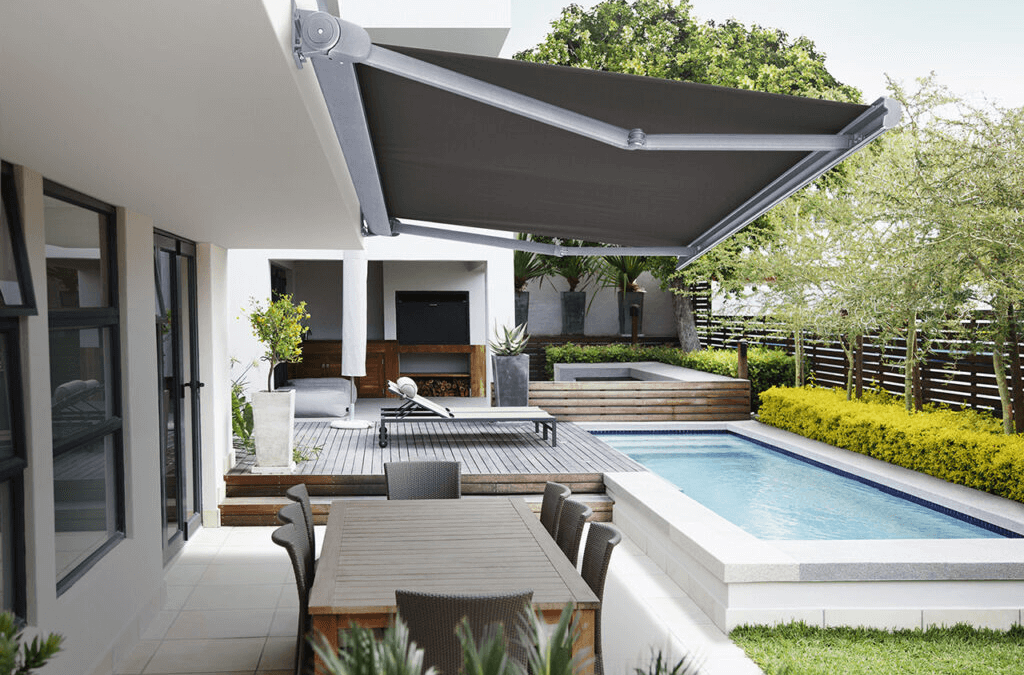
A folding arm awning — the most common form of retractable awning used in Melbourne — operates via a lateral arm mechanism. The arms fold out from the wall mount as the fabric extends. Importantly, there are no vertical posts or legs required. That means the full width beneath the awning remains open and unobstructed.
Additionally, the arms use a spring-tensioned system that keeps the fabric taut when extended. This prevents fabric pooling in light rain and maintains a clean, structured look from both inside the home and outdoors.
Most quality systems available through specialist installers like Statewide Outdoor Blinds’ folding arm awning range offer projection depths of 2 to 4.5 metres. That projection depth — how far the awning reaches out from the wall — is often more important than width when sizing the system for a deck or alfresco.
Therefore, before measuring for width, homeowners should first calculate the projection needed to shade their outdoor space fully during peak afternoon hours.
Cassette vs Open Arm: Which System Suits Melbourne Homes
Cassette Awning
- Fabric and arms fully enclosed when retracted
- Protected from UV, bird droppings, and debris
- Premium appearance — suits contemporary homes
- Higher upfront cost
- Longer fabric lifespan due to UV protection when stored
- Better suited to Melbourne’s unpredictable weather cycles
Open Arm Awning
- Fabric rolls onto an exposed barrel when retracted
- Arms remain visible at all times
- More affordable entry-level option
- Fabric exposed to UV and debris when not in use
- Suitable for sheltered positions with lower exposure
- Easier to access for DIY maintenance
For most Melbourne homeowners, the cassette system offers a stronger long-term return. However, the open arm system remains a practical choice for sheltered installations where the awning is used frequently enough that the fabric rarely sits exposed for extended periods.
Ultimately, the choice between cassette and open arm comes down to exposure level, usage frequency, and budget. Statewide Outdoor Blinds can assess your specific installation and recommend accordingly.
Verified Fact
According to Wikipedia’s overview of awning systems, cassette-style retractable awnings were developed specifically to protect the fabric and mechanism from weather exposure during retraction, significantly extending product service life compared to open barrel systems.
Motorised vs Manual: The Case for Automation in Melbourne
This is one of the most debated questions among Melbourne homeowners considering a new awning. Both systems extend and retract the awning effectively. However, the comparison shifts considerably when Melbourne’s rapid weather changes are factored in.
Manual Retractable Awnings
Manual systems use a hand crank to extend and retract the awning. They are mechanically simple, relatively inexpensive, and require minimal maintenance. For smaller awnings in sheltered spots, manual operation is perfectly adequate. That said, manually cranking a wide awning during a sudden squall is neither easy nor safe.
Motorised Retractable Awnings
Motorised systems operate via a remote, wall switch, or smart home integration. They retract the awning instantly at the press of a button. More importantly, when paired with a wind sensor, they retract automatically without any human input at all. In Melbourne’s sudden cool change conditions, that automatic response can prevent significant storm damage.
Moreover, motorised folding arm awnings support smart home integration through platforms like Somfy — a topic covered in detail further in this article. The additional upfront cost for a motor is generally $400 to $900, depending on awning size and motor grade, based on industry supply data as of mid-2026.
Verified Fact
Somfy Group, the global leader in motorisation for blinds and awnings, reports that motorised awning systems reduce the incidence of wind damage compared to manual-only systems, specifically because automatic wind sensors eliminate the reaction time delay that occurs when homeowners are away or asleep. Source: Somfy Australia.
Wind Safety, Ratings, and Severe Wind Gusts
Wind safety is arguably the most important and most misunderstood aspect of retractable awnings in Melbourne. Many homeowners assume their awning will handle any weather. Unfortunately, that assumption leads to torn fabric, bent arms, and wall anchor failures.
Understanding Awning Wind Ratings
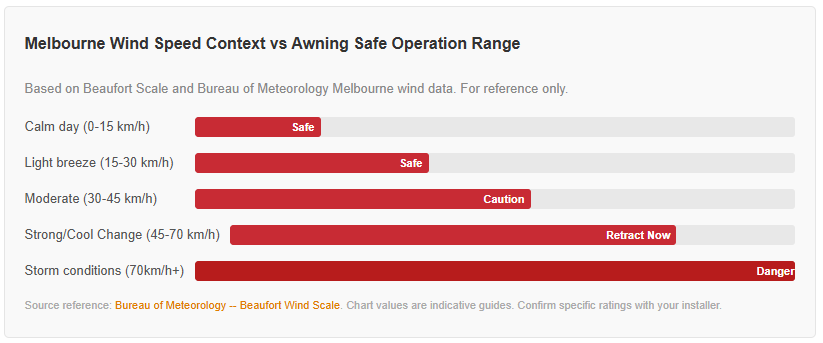
Most quality folding arm awnings carry a Beaufort wind rating. When extended, most systems are designed for Beaufort Force 3 to 4 conditions — roughly 20 to 40 km/h. Beyond that range, extended awnings are at risk. Melbourne’s sudden cool changes regularly reach Force 6 to 7, or 40 to 60 km/h, with gusts exceeding 80 km/h in some coastal and exposed western suburbs.
Consequently, relying on a manual awning during a southerly buster requires the homeowner to notice the wind change and retract the awning in time. That is simply not realistic when weather changes arrive within minutes.
Wind Sensors: How They Work in Melbourne Conditions
A wind sensor mounts near the awning — typically on the fascia or roof line — and continuously monitors wind speed. When speed exceeds the pre-set threshold, the sensor sends a signal to the motor, which retracts the awning automatically. The process takes approximately 30 to 60 seconds for a standard-sized system.
Additionally, quality wind sensors pair directly with Somfy motors and can integrate with the broader smart home system, sending retraction notifications to your phone when a wind event triggers the system.
Choosing the Best Awning Fabric for Melbourne Sun and Rain
Fabric choice directly affects performance, durability, UV protection, and maintenance requirements. Melbourne’s combination of high UV index days, occasional heavy rain, and salty coastal air in bayside suburbs means fabric selection genuinely matters.
Solution-Dyed Acrylic
This is the premium standard for retractable awnings in Australia. The pigment is baked into the fibre during manufacturing — not applied as a surface coating. Therefore, the colour does not fade from the outside in. It fades uniformly at an extremely slow rate. Most quality solution-dyed acrylic awning fabrics carry a 5 to 10 year fade warranty from Australian distributors.
Furthermore, solution-dyed acrylic is naturally water-resistant and mould-resistant. Light rain runs off the surface without saturating the fabric. The fabric does not provide waterproofing in heavy downpours, but it handles Melbourne’s typical spring showers without issue.
PVC-Coated Polyester
PVC fabrics are fully waterproof. They are popular for cafe blinds and more enclosed applications. However, for folding arm awnings, PVC fabric is heavier, less breathable, and prone to cracking in extreme heat. Consequently, most experienced Melbourne installers recommend solution-dyed acrylic for folding arm applications and reserve PVC for fixed or slide track systems.
Shade Mesh Fabric
Shade mesh provides UV protection while allowing air circulation. It does not offer rain protection. Nevertheless, for north-facing decks where airflow matters as much as shade, shade mesh fabric can make the outdoor space more comfortable during still summer afternoons.
“The most common mistake Melbourne homeowners make is choosing fabric based on colour alone. Fabric composition determines longevity. A beautiful fabric that fades in three years is never good value.”
Deck Orientation: Why North and West-Facing Decks Need Different Solutions
Deck orientation is a critical factor that many awning guides overlook. In Melbourne, the sun’s path means that north and west-facing decks receive fundamentally different solar exposure — and therefore require different shading approaches.
North-Facing Decks
North-facing decks receive the most consistent year-round sun exposure in Melbourne. In summer, the sun is high in the sky, meaning a retractable awning with a good projection depth will block the overhead angle effectively. Moreover, north-facing decks benefit enormously from retractable systems because the awning can be retracted in winter to allow warming winter sun through.
A retractable awning for a north-facing deck in Melbourne is therefore arguably the most efficient use case for the product. Fixed shade structures block winter sun unnecessarily. A retractable system gives full seasonal control.
West-Facing Decks
West-facing decks in Melbourne receive intense afternoon sun — often during the hottest part of the day. The low angle of late-afternoon sun means a standard horizontal awning provides less effective coverage than on a north-facing deck. In this case, combining a retractable awning with Ziptrak blinds on the western side or ZipScreen blinds creates a more complete shading solution that handles both the overhead and the low-angle western sun.
Retractable Awning vs Shade Sail: An Honest Comparison
Melbourne homeowners frequently debate shade sails versus retractable awnings. Both provide outdoor shade. However, their performance profiles are quite different, and the better option depends heavily on the specific application.
Retractable Awning
- Retractable — full seasonal control
- Higher upfront cost
- No posts required beneath the shaded area
- Wind sensor option for auto-retraction
- Professional installation typically required
- Can integrate with smart home systems
- Longer lifespan with good maintenance
Shade Sail
- Fixed or semi-permanent
- Lower upfront cost in most cases
- Requires anchor points — posts or walls
- Blocks winter sun year-round
- UV protection dependent on fabric rating
- No motorisation available
- Typically 5 to 7 year lifespan for quality fabrics
For most Melbourne homeowners with a defined deck or alfresco area, a retractable folding arm awning offers superior long-term value. However, shade sails remain useful for pools, play areas, and car parks where post anchoring is practical and permanent coverage is the goal.
Cost Guide for Retractable Awnings in Melbourne (Mid-2026)
Note: All prices below reflect general market ranges as of mid-2026. Actual costs vary based on supplier, product specification, installation complexity, and site conditions. Always obtain itemised quotes from licensed installers. Statewide Outdoor Blinds can provide a free, no-obligation measure and quote.
Mid-2026Indicative Price Ranges — Melbourne Supply and Install
The following ranges are based on general industry data and representative quotes. They are not fixed prices. Individual specifications, wall types, motorisation, and fabric grades will affect final pricing significantly.
Entry Level
$1,800 – $2,800
Manual open arm, standard fabric, up to 3.5m wide. Supply and basic install.
Mid Range (Most Popular)
$3,000 – $4,500
Motorised cassette awning, solution-dyed acrylic, 4-5m wide. Full install included.
Premium
$4,500 – $7,000+
Wide-span motorised cassette, Somfy motor, wind sensor, smart home integration.
Additional costs to consider: wind sensor addition ($200-$450), Somfy smart home integration ($150-$350 additional), structural wall reinforcement if required (variable), and motorisation wiring if hardwiring is needed. Always confirm with your installer. Prices are indicative as of mid-2026only.
What Drives the Cost of a Folding Arm Awning in Melbourne
- Width and projection: Larger awnings use more material and require more robust arms.
- Motorisation: Motor grade and whether hardwiring is required affects cost significantly.
- Cassette vs open arm: Cassette systems cost more to manufacture and install.
- Fabric grade: Solution-dyed acrylic from premium manufacturers costs more upfront.
- Wall substrate: Brick, weatherboard, and rendered concrete all present different anchor challenges.
- Storey height: Second-storey installations require additional equipment and safety compliance.
What Happens on Installation Day
Understanding the installation process helps homeowners prepare their home and set realistic expectations. A standard folding arm awning installation in Melbourne typically takes two to four hours for a single-unit residential installation.
- Pre-install site check: The installer confirms wall substrate, anchor point positions, and motorisation wiring path.
- Wall anchoring: Heavy-duty stainless or galvanised anchors are drilled into the structural wall. Fixings must penetrate into masonry or framing — not just render or cladding.
- Awning bracket mounting: The head box or bracket assembly is levelled and secured. This step determines whether the awning hangs correctly when extended.
- Motor wiring (motorised systems): If hardwired, this step requires electrical work. A licensed electrician may be required depending on scope.
- Awning arm and fabric assembly: Arms are attached, fabric tensioned, and projection pitch set. Projection pitch — the angle of the awning when extended — should direct rainwater away from the house.
- Wind sensor installation (if included): The sensor is mounted on the fascia or soffit and paired with the motor.
- Full operation test: The installer tests manual or motorised operation, wind sensor trigger, and checks fabric tension across the full span.
Additionally, reputable Melbourne installers will walk through basic maintenance requirements and explain the warranty coverage before leaving. If your installer skips this step, ask for it specifically.
Somfy Smart Home Integration for Melbourne Awnings
Somfy is the dominant brand in the motorised awning and blind automation space in Australia. Their TaHoma smart home platform allows Melbourne homeowners to control retractable awnings, outdoor blinds, and security roller shutters from a single app.
Moreover, Somfy’s TaHoma Switch integrates with Amazon Alexa, Google Assistant, and Apple HomeKit. That means voice control, scheduled automation, and geofencing become possible. For example, an awning can be programmed to extend automatically when the temperature exceeds 28 degrees and retract when wind speed exceeds 40 km/h — all without manual input.
Sun Sensor Integration
In addition to wind sensors, Somfy sun sensors detect solar intensity and automatically extend the awning when sunlight reaches a pre-set lux level. This is particularly useful for north-facing Melbourne decks during spring and autumn, when the sun may be intermittent throughout the day.
Integration with Other Statewide Outdoor Blinds Products
A fully integrated Melbourne outdoor living setup might combine a motorised retractable awning with Ziptrak blinds, E-Zip blinds, and plantation shutters — all controllable from the Somfy TaHoma app. This level of integration significantly improves energy efficiency and outdoor lifestyle comfort throughout Melbourne’s variable seasons.
Maintenance That Extends Awning Life in Melbourne
A quality retractable awning represents a meaningful investment. Accordingly, regular maintenance directly determines whether it lasts 8 years or 15+ years in Melbourne’s conditions.
Seasonal Maintenance Checklist
- Spring clean: Extend the awning fully. Brush off any debris, bird droppings, or mould. Use a soft brush and mild soapy water — never solvents or bleach on acrylic fabric.
- Check arms and springs: Look for any tension loss in the spring arms. Uneven tension causes the fabric to sag on one side, which increases wind stress.
- Inspect wall fixings: Check that anchor bolts remain tight. Melbourne’s thermal expansion and contraction cycles can gradually loosen fixings over time.
- Test motor operation: Run the awning through several full extend-retract cycles. Any grinding or hesitation indicates the motor or drive mechanism needs attention.
- Lubricate pivot points: Apply dry PTFE lubricant to arm pivot joints annually. Avoid oil-based lubricants that attract grit.
- Check wind sensor calibration: Test the wind sensor annually. Most Somfy sensors have a self-test mode accessible through the app.
- Retract before storms: This remains the single most important maintenance behaviour. No awning survives repeated storm exposure without damage.
Furthermore, consider pairing your awning maintenance schedule with a general check of your outdoor blinds and cafe blinds if installed. Consistent maintenance across all outdoor shading products keeps the total system performing correctly.
Frequently Asked Questions About Retractable Awnings in Melbourne
The following questions reflect the most common queries from Melbourne homeowners researching retractable awnings. Answers are based on verified industry data and local installation experience as of mid-2026.
How much does a retractable awning cost in Melbourne?
As of mid-2026, supply and installation of a retractable folding arm awning in Melbourne ranges from approximately $1,800 for a basic manual open arm system to $7,000+ for a wide-span motorised cassette system with wind sensor and smart integration. Mid-range fully installed motorised units typically cost between $3,000 and $4,500. Always request itemised quotes. Prices will vary with size, fabric grade, and site complexity.
What is the average cost of a retractable awning?
Based on mid-2026Melbourne market data, the average installed cost for a mid-range motorised retractable awning across a 4 to 5 metre span is approximately $3,200 to $4,200. This figure includes the motor, cassette housing, solution-dyed fabric, and standard installation on a brick or masonry wall.
What is the disadvantage of a retractable awning?
Retractable awnings provide no side wind protection. They require retraction during high winds and storms. Without a wind sensor on a motorised system, a homeowner must manually retract the awning before weather events. They also offer less structural enclosure than a permanent pergola or fixed roof system.
Are retractable awnings worth the money?
For north and west-facing Melbourne decks, yes — clearly. They extend outdoor usable hours, reduce indoor cooling loads, add property appeal, and offer full seasonal control unavailable with fixed structures. The return on investment improves significantly when the awning is used frequently and maintained correctly.
What is the life expectancy of a retractable awning?
Quality retractable awnings with solution-dyed acrylic fabric last 10 to 15 years with proper seasonal maintenance. The mechanical components — arms, springs, and motors — generally outlast the fabric. Fabric replacement is possible without replacing the entire unit, which extends the overall system lifespan further.
How much should I expect to pay for professional installation?
Installation labour in Melbourne typically ranges from $300 to $800 depending on wall substrate, installation height, motorisation wiring complexity, and whether structural modifications are required. Second-storey installations and heritage wall types generally cost more.
What is the best retractable awning system available?
The best system depends on your specific application. However, a cassette-style folding arm awning with solution-dyed acrylic fabric, a quality Somfy motor, and a wind sensor is consistently regarded as the premium standard for Melbourne residential installations. Statewide Outdoor Blinds can assess your site and recommend the most appropriate specification.
Can a retractable awning be left open in the rain?
Solution-dyed acrylic fabric handles light rain well — water beads and runs off the surface. However, leaving any retractable awning fully extended during heavy rain creates pooling risk, excess fabric stress, and potential arm damage. During storms, always retract the awning regardless of fabric type.
Does a retractable awning add value to a Melbourne home?
Professionally installed outdoor shading consistently improves buyer appeal and functional living space. While exact dollar-for-dollar return varies by property, real estate agents across Melbourne commonly cite quality outdoor living improvements — including awnings and outdoor blinds — as features that support sale prices in the current market.
How wide can a retractable awning span?
Most folding arm awning systems span between 2 metres and 7 metres as a single unit. Wider coverage is achievable by linking two units on a shared motor or installing parallel units. For spans exceeding 6 metres, confirm structural wall capacity with your installer before committing to a specification.
Do I need council approval for a retractable awning in Melbourne?
In most Melbourne residential zones, retractable awnings fall within standard outbuilding exemptions under the Planning and Environment Act 1987 (Vic) and do not require a planning permit. However, properties with heritage overlays, body corporate restrictions, or unusual siting conditions should confirm with their local council before proceeding. Source: Planning Victoria.
What wind speed can a retractable awning handle safely?
Most quality folding arm awnings are rated for Beaufort Force 3 to 4 when extended, which corresponds to approximately 20 to 40 km/h. Melbourne’s sudden cool changes regularly exceed this. A Somfy wind sensor triggers automatic retraction when wind reaches the set threshold — typically 35 to 45 km/h — protecting the system without requiring homeowner intervention.
Can I install a retractable awning on a second storey in Melbourne?
Yes, second-storey installations are common in Melbourne’s townhouses and multi-level homes. They require appropriate wall anchor capacity, extended installation equipment, and potentially additional safety compliance measures. Labour costs are typically higher for elevated installations. Always use a licensed and insured installer for elevated work.
How do I clean retractable awning fabric?
Extend the awning fully. Use a soft-bristle brush with mild soapy water to remove debris and surface mould. Rinse with clean water and allow the awning to dry fully before retracting. Never use bleach, solvents, or pressure washers on acrylic fabric. For stubborn mould, specialist awning fabric cleaners are available from outdoor blinds suppliers across Melbourne.
Making the Right Choice: Retractable Awnings in Melbourne
When it comes to outdoor shading in Melbourne, retractable awnings consistently deliver the best combination of flexibility, performance, and return on investment. They handle summer heat on north-facing decks, extend outdoor usability into spring and autumn, and — when properly specified with a motorised system and wind sensor — protect themselves automatically during Melbourne’s notorious weather changes.
Furthermore, the choice between cassette and open arm, motorised and manual, solution-dyed acrylic and mesh fabric — all of these decisions have clear right answers once your specific deck orientation, exposure level, and budget are factored in. That is precisely why a professional site assessment is more valuable than any online cost calculator.
Statewide Outdoor Blinds supplies and installs retractable awnings across Melbourne, alongside Ziptrak blinds, E-Zip blinds, outdoor blinds, cafe blinds, slide track blinds, window awnings, plantation shutters, and security roller shutters. With the full range under one roof, a complete outdoor living solution is achievable without dealing with multiple contractors.