



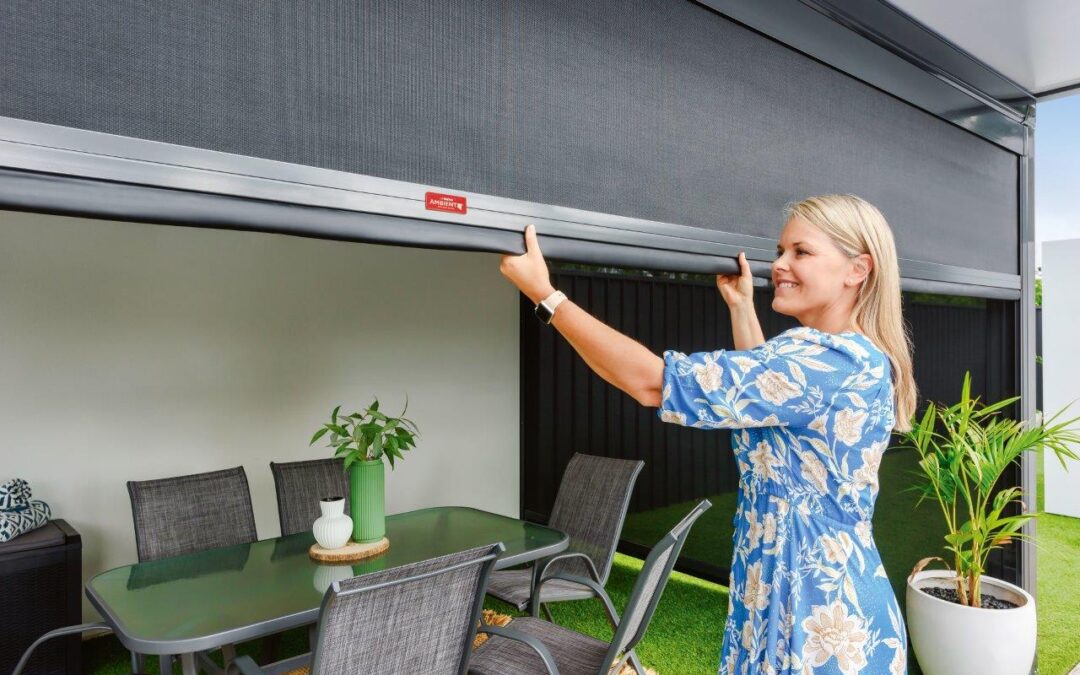
Most people in Melbourne don’t start looking at outdoor blinds because they want to. They start because something isn’t adding up to their space or their vision. Either the blinds move or lift at the sides, which lets wind through or makes noises that pierce your eardrums. You take every possible step to adjust it, but it doesn’t work and eventually stops being used altogether. That’s a major trade-off with traditional outdoor blinds. But it is the Slide track blinds in Melbourne that fix the problem.
Instead of hanging loose, the fabric is held inside side rails, so it stays in place even when the wind picks up. No gaps, no flapping around — just a blind that actually does what it’s supposed to do.
Slide track blinds are outdoor blinds that run inside guide rails, keeping the fabric locked in position and stopping the gaps you get with traditional blinds.
It has become the most requested outdoor blind system for residential homes. So, Statewide Outdoor Blinds has brought you a guide that breaks down how they work, how systems like Ziptrak, E-Zip, Slide Track, and ZipScreen compare, what the systems cost around Melbourne, and how to work out what makes sense for your space.
What Are Slide Track Blinds?
Slide track blinds — also called zip track blinds or guided blinds— are outdoor blind systems where the fabric travels within aluminium guide rails fixed to the sides of the opening. Unlike a traditional outdoor blind that hangs free, the zip or bead sewn into both edges of the fabric is captured in the rail channel.
The result is a blind that cannot be pushed aside by wind, cannot gap at the sides, and creates a sealed edge from top to bottom when closed. This is what separates slide track blinds from every other outdoor blind category — not the fabric, not the motor, but the track.
If you’re still comparing systems, it’s worth reading our Outdoor Blind Company Melbourne guide first to understand the different options available.
How Track-Guided Technology Works
The mechanism is straightforward. Two aluminium channels — the guide rails — are fixed to the vertical edges of the opening: one on the left side, one on the right. The blind fabric has a zip cord or plastic bead bonded along both side edges. As the blind is raised or lowered, this zip or bead slides within the channel.
Because the fabric is continuously captured in the rail, it cannot pull away from the sides at any point. Wind pushes against the face of the blind — but the sealed edge patio blinds design means there is nowhere for the fabric to go. It stays flat, stays sealed, and continues to perform exactly as it did on a still day.
| The track does not just guide the blind — it holds it. That is the engineering difference that changes how outdoor blinds perform in Melbourne’s weather. |
Fabric and Finishing Options That Actually Matter
The track system does the heavy lifting, but the fabric and finishing details are what determine how the blind feels day to day.
Most slide track blinds in Melbourne are installed using mesh fabrics like Vistaweave or Visiontex. Both are designed for outdoor use — they cut glare, reduce heat, and still let you see out, which is why they are used so widely on alfresco areas and windows.
The difference usually comes down to how much light and airflow you want. Some homeowners prefer a more open weave for visibility, while others go for a tighter weave for privacy and wind reduction. This is something that’s easier to decide during a measure when you can see samples in your own space.
Pelmets are another detail that often gets overlooked. They sit at the top of the blind and cover the rolled fabric. On paper, they’re optional, but on exposed Melbourne sites, they make a noticeable difference. They protect the blind when it’s rolled up and give the whole installation a cleaner finish.
It’s not the main selling point like the track system — but these small choices are what separate a basic install from one that still looks good and works properly years later.
Ziptrak vs E-Zip vs Slide Track vs ZipScreen
Not all guided blinds Melbourne installers offer are the same system. We at Statewide Outdoor Blinds install four distinct track-guided products. Each has a different mechanism, aesthetic, and ideal application. Let’s see the different types in the following sections-
1. Ziptrak Blinds Melbourne — Spring-Balanced, Stop Anywhere
Ziptrak is an Australian-designed and Australian-made system. Its defining feature is spring-balanced operation — the blind stops and holds at any height without a crank, lock, or clip. You push up or pull down, and it stays exactly where you leave it. No fixed stopping positions. Completely adjustable.
Many homeowners compare slide track systems with Ziptrak blinds in Melbourne specifically because of this ease of daily use. The spring balance means no mechanical effort — just move it to where you want it. Available in sunscreen fabrics and clear PVC.
2. E-Zip Blinds Melbourne — Crank-Free, Flush Rail Aesthetic
E-Zip is a European-designed crank-independent outdoor blind system operated by motor or manual hand pressure along the side tracks. The guide rails sit flush with the structural frame of the opening — producing a minimal visual profile when the blind is open that suits contemporary architecture.
Popular across Melbourne’s inner east and bayside suburbs where the look of the system when open is as important as performance when closed. Motorised operation is standard in most E-Zip configurations.
3. Slide Track — Australian Made, Heavy-Duty Rail
The Slide Track system is Australian-made with a heavier-gauge guide rail than standard residential systems — built for large openings and exposed sites, where wind loads are significant. Crank-operated for manual use, with motorisation available for larger installations.
The preferred outdoor blinds Melbourne commercial operators choose for restaurants, hospitality venues, and large alfresco areas are those that provide a more robust mechanism than standard residential systems do.
4. ZipScreen Blinds — External Solar Shading for Windows
ZipScreen is a track-guided external solar shading blind designed for windows rather than open alfresco areas. The sunscreen mesh fabric is available in different openness factors — the percentage of the fabric area that is open — reducing heat gain through the glass while maintaining outward visibility.
Best for west and north-facing windows where afternoon sun is the primary problem. Blocking heat externally before it reaches the glass is significantly more effective than internal curtains or blinds.
| System | Operation | Sealed Edge | Best For | Motorisation |
| Ziptrak | Spring-balanced — stop at any height | Yes | Alfresco, pergola, everyday residential use | Optional upgrade |
| E-Zip | Crank-free — motor or hand push | Yes — flush rail | Contemporary and inner-city homes | Standard |
| Slide Track | Crank-operated | Yes — heavy guide rail | Large openings, commercial, exposed sites | Available |
| ZipScreen | Motor or crank | Yes | West/north-facing windows, solar shading | Motor standard |
Why Slide Track Blinds Perform Better in Melbourne Weather
Melbourne’s climate is the reason track-guided outdoor blinds have taken over from traditional systems. Two specific weather conditions make the difference obvious.
The Southerly Change — Melbourne’s Wind Test
The southerly change is Melbourne’s most sudden weather event — a shift from hot northerly conditions to a cool, gusty southerly that arrives in minutes with wind speeds regularly exceeding 60 kilometres per hour. A free-hanging outdoor blind fails under these conditions: billowing, stressing at the side edges, and wearing the fabric at every stress point.
A slide track blind has nowhere to move. The sealed edge patio blinds design keeps the fabric in the rail under all wind conditions encountered in normal use. Motorised outdoor track blinds with a wind sensor retract automatically when wind exceeds a preset threshold — no manual intervention required.
Melbourne Coastal and Suburban Installations
Slide track blinds are widely installed across Melbourne suburbs, including Werribee, Point Cook, Geelong, and the Mornington Peninsula — areas where onshore wind, high UV, and salt-laden air make a sealed-edge system genuinely necessary rather than just preferable.
We assess each site individually. The fixing specification and fabric recommendation for a coastal home in Werribee or Point Cook differ from an inner-suburban installation. This is part of the free in-home measure — not an add-on.
| A homeowner on Melbourne’s bayside had a conventional outdoor blind that was repeatedly blown back by onshore wind, tearing the fabric at the side edges within two seasons. The Ziptrak replacement — sealed edge in aluminium guide rails — held through all wind conditions in the following two years, including a 65km/h gust event recorded by the local weather station. A free in-home measure helps determine the right system based on your space, wind exposure, and budget. |
Slide Track Blinds Melbourne Cost Guide
Cost is one of the most searched topics for slide track blinds in Melbourne — and one of the least clearly answered. Prices vary by system, fabric, opening size, and whether motorisation is included or not. The figures below are approximate installed price ranges per metre of width.
| System | Approximate Installed Price (Per Metre Width) | Motorisation | Notes |
| Ziptrak — sunscreen fabric | $400 to $700 per metre | Optional — $300 to $600 extra | Spring balance included; price varies by fabric openness and colour |
| Ziptrak — clear PVC | $450 to $750 per metre | Optional | PVC weight requires correct spring balance specification |
| E-Zip | $500 to $800 per metre | Standard in most configs | Flush guide rail adds to cost; clean open profile |
| Slide Track | $450 to $750 per metre | Available for larger installs | Heavy gauge rail; suited to wide openings and commercial use |
| ZipScreen — window solar | $350 to $650 per metre | Motor standard | Openness factor selection affects price; UV-stabilised fabrics available |
These are guide ranges only. The exact price for your installation depends on dimensions, fabric selection, the fixing complexity, and site conditions. Statewide Outdoor Blinds provides a fixed price after the in-home measure — no estimates, no hidden charges, all GST included.
| 🔗 Also useful: Our Cafe Blinds Melbourne page covers how to get information about the pricing and specs for hospitality and commercial alfresco installations. |
Which System Is Best for Your Home?
The right choice depends on three things: your space, your wind exposure, and your budget. Let’s see some genuine recommendations that you can use.
- For everyday residential alfresco use where ease of operation matters most — Ziptrak. The spring balance means the blind moves to wherever you want it with no effort.
- For contemporary homes where the profile of the open system matters architecturally — E-Zip. The flush guide rail creates the cleanest open aesthetic of any track-guided system.
- For large openings, commercial applications, or sites with significant wind exposure — Slide Track. The heavy-gauge guide rail is built to handle what lighter residential systems cannot.
- For windows rather than open alfresco spaces, where solar heat gain through glass is the primary problem — ZipScreen. External shading on west and north-facing windows reduces cooling costs noticeably.
In practice, many Melbourne homes use more than one system — Ziptrak on the alfresco, ZipScreen on west-facing windows. We install across all four systems and will recommend the right combination for your property during the home consultation.
Conclusion
All in all, we can say that slide track blinds in Melbourne are such transformational products. They are the most effective outdoor blind system available in our stock. The sealed guide rail solves the wind problem that every other outdoor blind has always had. Not just a slide track, you also have other options that you can choose from. This makes it easier for you to get the right thing.
At the end of the day, it is about enjoying your outdoor space instead of constantly adjusting it. Melbourne’s weather might be unpredictable, but your blinds don’t have to be.
Give Statewide Outdoor Blinds a call on 1300 559 604 and see how much easier outdoor living can be.
FAQs
Ziptrak uses a spring-balanced mechanism so the blind stops and holds at any height without a crank — you simply push or pull. E-Zip is a crank-independent system operated by motor or hand pressure along the side track, with a flush guide rail that creates a cleaner profile when open. Both have a sealed edge in an aluminium guide rail that eliminates wind lift. E-Zip suits contemporary homes where aesthetics when open matter as much as performance when closed.
Ziptrak blind installed prices in Melbourne range approximately $400 to $700 per metre of width for sunscreen fabric, and $450 to $750 per metre for clear PVC. Motorisation adds approximately $300 to $600 per blind. These are guide ranges — the exact price depends on dimensions, fabric, and site conditions. We provide a fixed price after an in-home measure. All GST included. Call 1300 559 604.
Yes — they are the most appropriate system for coastal and exposed Melbourne sites. The sealed guide rail prevents wind lift under onshore conditions that would damage a free-hanging blind within a season or two. We specify the right fixing strength and UV-stabilised fabric for salt-air environments. Suburbs including Werribee, Point Cook, and Mornington Peninsula properties are regularly installed.
Ziptrak, E-Zip, Slide Track, and ZipScreen. They provide far better wind performance than free-hanging blinds because the sealed edge cannot lift. For maximum resistance on large or exposed openings, the Slide Track heavy-gauge guide rail provides extra structural rigidity. Motorised outdoor track blinds with an automatic wind sensor are recommended for any exposed Melbourne site.
Yes. All four track-guided systems are available with motorisation — remote control, wall switch, or smart home integration. A wind sensor can be added to any motorised system: when wind exceeds a preset speed, the blind retracts automatically. This is particularly valuable in Melbourne, where rapid southerly weather changes can arrive without warning.